



 Newsletter
 Search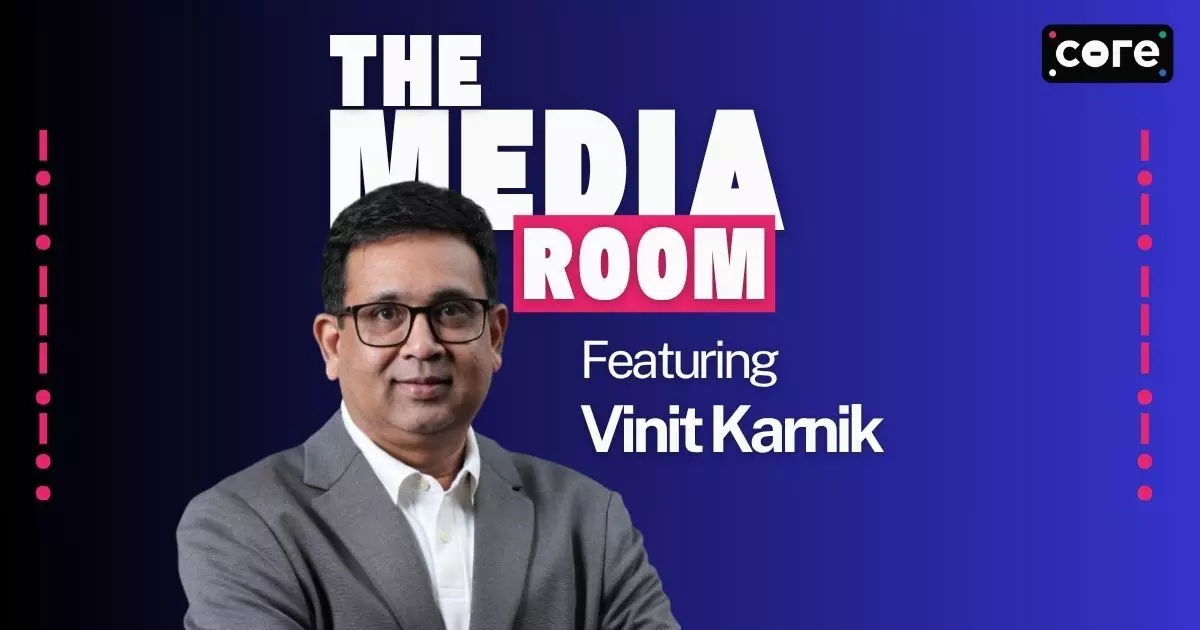
Vinit Karnik on India’s Sports Economy, IPL Growth & Media Money
- Podcasts
- Published on 8 April 2026 7:30 PM IST

India’s sports sponsorship economy crosses $2 billion
In this episode of The Media Room, Vanita Kohli-Khandekar speaks with Vinit Karnik, Head of Entertainment & Sports at WPP Media, for a deep dive into the economics of India’s fast-growing sports ecosystem.
Vinit unpacks key insights from WPP’s Sporting Nation report, including India’s sports sponsorship economy crossing the ₹2 billion mark and the overwhelming dominance of cricket, which accounts for nearly 80% of the market. He explains how media rights, advertising, and athlete endorsements are driving growth, and why the IPL continues to be one of the most valuable sports properties in the country.
The conversation explores the challenges facing emerging sports like football, kabaddi, and badminton, from governance and infrastructure gaps to the difficulty of building consistent star power. Vinit also breaks down the evolving business of cricket - from rising franchise valuations and media rights economics to the long-term potential of new revenue streams such as non-live content and fan monetisation.
They also discuss the role of advertisers, the importance of grassroots investment, and why sports remains one of the few categories that can guarantee large-scale appointment viewing in an increasingly fragmented media landscape.
If you want to understand how India’s sports economy is evolving, where the money is coming from, and what the future of sports monetisation looks like - this episode is essential viewing.
NOTE: This transcript is done by a machine. Human eyes have gone through the script but there might still be errors in some of the text, so please refer to the audio in case you need to clarify any part. If you want to get in touch regarding any feedback, you can drop us a message on [email protected].
—
TRANSCRIPT
Vanita Kohli-Khandekar: Hello and welcome to the media room. India loves its cricket and nothing says this as much as the WPP media report which just came out a couple of weeks back on Sporting Nation building a legacy. It's a report they've been doing for I think eight or nine years now and no I think it's more than that but it's a report and every year the same questions come up but every year the numbers grow so it's a nice it's a nice piece of work which I look at which tells you how the media ecosystem around sports is growing, rights, advertising all of it.
To speak to me more about the Sporting Nation report I have with me Vineet Karnik who heads the entertainment and sports vertical for WPP media across South Asia. Over to Vineet. Hi Vineet, welcome to the media room.
Nice to have you here. I think this is your first time on my show.
Vinit Karnik: Yes, absolutely first time. Thank you for inviting me on the media room. I think it's a fabulous effort that you're taking.
I think it's really fantastic.
Vanita Kohli-Khandekar: Okay, thanks. Vinit, you've just come out with Sporting Nation once again every year. Could you just unpack the key highlights of the report for my viewers please and then we'll get into more details.
Vinit Karnik: Yeah, sure. So the first and foremost, Vanita, I think the headline which is really exciting is that the first time our sponsorship economy from a sports perspective has crossed the 2 billion mark. So it's currently at around 8800 crores.
So I mean that's a very big headline. Second is cricket contributes to almost 80 percent of our sporting sponsorship economy. So which obviously gives us a very clear headway that cricket is obviously the biggest sport in the country.
I mean obviously no prices to guess that though. Having said that, another interesting point is the IPL teams. We have 10 IPL franchises and there is a sponsorship model there as well.
So there is a sponsorship and team sponsorship. I think for the first time, we have seen IPL teams crossing a thousand crore mark averaging about hundred odd crores per team which is a very healthy sign which basically means that from a revenue perspective, from a monetization perspective, I think sports or cricket for that matter is in an absolute healthy situation because there is great momentum on broadcast plus streaming. There is equal amount of momentum on the central sponsorship which BCCI takes care and with the thousand crore mark crossing, I think IPL franchises are creating a robust revenue and monetization model around that as well.
So that's third point. Fourth point is around the entire emerging sports. So while there has been a sluggish 2025 for emerging sports, I think our sports, our emerging sports women like say for example, Neeraj Chopra is either finding newer ways to staying relevant, to reaching out to their audience, to do a great job from their perspective.
So I think the entire the show that Neeraj created which is non-live. That actually got a very good response from the audience. So that actually triggers a great momentum for others to follow.
A great amount of trend on cricketers starting their family offices. So for the latest being Shreyas Iyer. We already know that the likes of Virat Kohli, Hrithik Pandya already have family offices and I think it's very popular in Bollywood actually.
Our sportsmen are also riding that trend. Shreyas Iyer to be the latest imprint in that. That's another trend that we are looking at.
And last but not the least, our entire media industry which is TV plus streaming is contributing almost 51% to the 18,800 crores. So these are the five highlight points that I thought that we should add at the beginning of the show.
Vanita Kohli-Khandekar: Fantastic. So this 18,000 crore of the sports economy, 18,000 plus crore. This is essentially all the revenue that sports generates in this country?
Vinit Karnik: That's the brand interface. So for example, whatever advertisers advertise on broadcast or streaming for all sports, that's the number. All the sponsorship monies that go into on air and on ground sponsorship.
Third is the endorsement fees which athletes charge and brands pay. So these are the three main tenets of this 18,800 crores.
Vanita Kohli-Khandekar: So we're looking at the media and the celeb part of it. We're not saying ticket sales and that is all a different ecosystem.
Vinit Karnik: Is that correct? Entire ticket sales, match day revenue, ticket sales, merchandising is a separate thing which does not come into 18,800. Also what is not covered is the entire sports equipment retail.
So basically the reason why we do this report Vanita is for the marketing and advertising community to get the sense of what happens in the sporting landscape in India. So it's the interface for them to understand what's happening in cricket, what's happening in kabaddi, what's happening in other sports, what's happening in the athlete endorsement space and so on and so forth.
Vanita Kohli-Khandekar: It's very interesting you're saying that because eventually any sports popularity is driven by how popular it is on mass media and then media rights and when that whole thing comes into play is when that sport, I mean kabaddi is a great example and that brings me to my favourite question on this report. What is happening to emerging sports? We actually saw emerging sports drop from 15% to 11%.
What has happened there because you're talking football, hockey, kabaddi, they all together account for 11% while cricket is 89% which is good but why is the other sports not rising?
Vinit Karnik: So that's a great question and we should spend some time on that. So in fact, we are showing a degrowth of emerging sports to 12% in this report and I would take some time to explain why because it's very important for your audience to know that it's not about while cricket is the biggest sport, there is work happening in the emerging sport ecosystem but from a 2025 perspective, there is a decline. So the first biggest reason for the decline is that we didn't see ISL happening in 2025.
There was a pause in the Indian Super League so that itself is about three to four hundred crores pipe of Indian Super League. That's a football league. That's a football league which didn't happen.
I think more importantly, I think I just want to go back in 2018 and 2019 which is pre-covid era where ISL was doing extremely well, Kabaddi was doing fantastic, we had badminton as a league. What actually happened was because of covid, the entire momentum on emerging sports took a pause and currently, it's in the rebuilding stage. So for example, while 2025 we didn't see ISL but we will definitely are seeing ISL in a completely new avatar in 2026.
We will see Kabaddi happening. There is a revival of hockey that we are seeing. We saw the coming in, we have seen pickleball, we are seeing paddle which has got massive amount of community support that we are seeing over the last year and a half or two seasons of world premium because already happening.
So there is a momentum but the fact of the matter is post-covid, there has been a massive impact to the emerging sport economy and therefore, currently they are in the rebuilding stage. I think we need to give it another couple of years for it to somewhere come to the stages of 2018-2019 because if you see our report only around pre-covid, I think cricket was almost 85-86 percent and emerging sport had that you know 15-20 percent, 14-15 percent kind of a contribution there. So that's somewhere taken a hit and these are the reasons for that, Vanita.
Vanita Kohli-Khandekar: No but it can't only be covid because if the sport is building, I accept the covid factor but is there something else in the infrastructure, in the play, in the sport's ability to be televised because with Kabaddi, that was one big factor why the Mahindras and star and everybody got into it that it was a very televisable sport, short format. How much of that, how much of the infrastructure, what is the role that these things play? So when you look at badminton, we get stars every year, we get a Laksh Sen or a Sindhu or something but we do not seem to have and you mentioned this to me that cricket has built its thing over 30-40 years, more than that.
So a bit if you could illuminate my viewers on that one.
Vinit Karnik: So answer somewhere lies in your question only, Vanita that you're absolutely right that infrastructure, training facilities, support to the athletes from a support staff perspective is a very very important aspect of any athlete to succeed in the world stage or in any stage. So today the point I'm trying to make is somewhere the emerging sports will also have to look at the way they are governed and we have a great playbook in BCCI, we have a great playbook in ICC in terms of the way BCCI has governed cricket as a sport. The entire structure of cricket at a state federations level, the grassroot level, I mean the Ranji Trophy, the Devdara Trophy, the Irani Trophy, the entire grassroot programme which federation runs in different states and areas which actually is coming together and bringing the best talent to play cricket at a school level, at a college level.
I mean you have a Gayle Shield, you have a Harit Shield, you have so many different, there's a structure for cricket in India where a boy or a girl in a young stage who wants to take cricket as a professional career can actually ladder which they can imagine even from a parent perspective. It gives them confidence to invest that for time because we in India are very excited about 10th and 12th and graduation and masters. So somewhere the confidence building also needs to happen from a federation point of view.
I think the BCCI playbook if even the emerging sports like football, like Kabaddi, like badminton can even take 30-40 percent inspiration from them can make a very very good difference to those sports and I think somewhere that's not happening and that work needs to be done at a federation level where you actually really build a programme which gives the athletes that chance and to actually perform and climb that ladder.
The support system in terms of training facilities, the entire nutritional help that they need, the physiotherapy guidance that they need, all that has to come together for the talent to actually perform, that's one. Second, I think if you see over the period of time, cricket has done a fantastic job and we have got so many superstars within our cricketing ecosystem. Look at the first match of Rajasthan Royals this year, 52 or 53 that Vaibhav Suryavanshi hit, had almost a magical performance or a batting that he showed in the first match of Rajasthan Royals and know that there were two superstars from last year's IPL.
One was Aayush Chopra, second was Vaibhav Suryavanshi. I think these are the stars that make cricket the most invincible property. I think the two kids and everybody is following them this season.
Vaibhav already has done a fantastic job in his first match and we have obviously a long tournament to go. So I think somewhere down the line, the entire effort of building stars, star performers also keeps cricket going and these are some of the reasons which are very very important in making a sport bigger, making a league bigger and therefore making an athlete bigger.
Vanita Kohli-Khandekar: I'll just one or two more questions on these other sports that will come to cricket because I know a lot of viewers will be more interested in cricket. But you know, I thought PKL, I was very heartened with the growth of the professional Kabaddi league and I was like okay good and I remember interviewing a few Kabaddi teams and they were training in some place in Noida and the physiotherapists and the works, you know, it looked very professional and then it suddenly, you don't hear about PKL anymore. Badminton league, so much work had happened.
You yourself told me that you got Vodafone as a sponsor and then it peaked it out. But when the leagues reach this stage and then peaked it out, what goes off?
Vinit Karnik: I think badminton is a great example because today if you see, according to me, every two kilometres within our country or maybe five kilometres in our country, there is a badminton academy. Somebody is training kids playing badminton.
Vanita Kohli-Khandekar: My son plays for two hours every day.
Vinit Karnik: Absolutely. So, I think somewhere the answer lies in our conversation that we just had a couple of seconds back. I think the federations will have to have a very very clear governance strategy and a robust sustenance of that over a period of time because eventually, no athlete can govern or run a sport.
No professional trainer or a coach can take the responsibility of governing the sport. The governance of sport will have to be owned by the federation which actually runs it in the country or in the state. So, somewhere that playbook needs to be changed and needs to be completely reinvented in my mind.
Vanita Kohli-Khandekar: When you say playbook, you mean what? Because most federations are governed by politicians and BCCI, like you mentioned, is a good combination of politicians plus professionals. That is not true for other federations.
Vinit Karnik: That is true for other federations also, Vanita. So, federation run by a politician is not a problem. That's fine.
It is necessary also at times. Yeah, that's not a challenge. The problem is, are we taking the right steps?
Are we thinking long term or middle term towards making sure that sport becomes big, community accepts the sport, the sports stars within that? I mean, take an example of badminton. You had a Saina Sindhu as your poster girl.
Today, you have a Lakshya Sen as your poster boy. But after a couple of stars, like I think, if I remember, I think it was Amit Kumar or Amit in Kabaddi. I don't think we have so many stars in Kabaddi.
Okay, after Sunil Chhetri, I don't, I myself can't give you the third or the fourth name. Yeah. So we have not been able to build those consistent stars within the sports because the governance of the sport has not been consistent and up to the mark in terms of making sure the audience takes notice of that.
And make no mistake, India has a massive appetite for football as a sport. Okay, so if you ask me, which sport do I would think to be the second most popular sport in this country, without backing an eyelid or a doubt, I would say it's football. We have a massive amount of following for football.
But Indians do follow football, but European football, not Indian football. Now, that's the challenge. And that's the change we need to build in.
Vanita Kohli-Khandekar: Because European football has stars whom we can, who we look up to.
Vinit Karnik: Messi came to India, I think a month back, okay, the entire narrative or the event messed up because that much of energy, that much of fan intervention was there. So many people wanted to get a glimpse of that superstar, right? So we do have the appetite and the amount of money people have spent to go to stadiums to watch Messi in Kolkata, in Mumbai, in Hyderabad is not funny.
I mean, people have spent serious amount of money to have that seat on the dinner table or seat or catch a glimpse of Messi or take a picture with Messi. So that's not the, I mean, people are willing to spend for those experiences. But the governance and the product that we take to the fans needs to be absolutely professional.
Vanita Kohli-Khandekar: But Messi coming and people spending money to see him doesn't do anything for Indian football.
Vinit Karnik: Completely agree. I'm just, I completely agree with you. The point I was making on that is because people have the appetite to spend.
Eventually, the sport is governed by the fans spend so that sports become bigger. Today, if there are media rights, money being given from a broadcast to the federation, or like say a BCCI in case of cricket, okay. Geostar is paying that money because they know there is an audience who's going to be coming and watching that sport on the channel or on the streaming platform, where an advertiser are going to be spending top dollars to advertise.
So it's somewhere linked to the fans.
Vanita Kohli-Khandekar: Correct. You know, to come to cricket now for a bit, there's a recent Media Partners Asia report which came out last week, which said that, and I remember this is something I had commented on because the last round of rights was pretty steep, you know, you're talking about 48,000 odd crores for digital plus TV. And that was to separate players who happened to merge later.
And the report says that IPL rights, not necessarily cricket, will stagnate because the current set of rights which finish in 27, would end up making a loss of 1.8 to 2 billion dollars. Rupees, I don't want to convert right now, because the rate keeps changing, but 1.8 to 2 billion dollars. And they said that there will be some correction.
But on the other hand, you have an RCB, which was valued at 1.78 billion dollars by this consortium, which is Blackstone and others. You know, I find that strange and contradictory. Anything you want to say there on that one?
Vinit Karnik: Absolutely. Again, I mean, there is an answer in your question. But let me break that down.
So let's jog our memory to the first season of IPL, okay, where, you know, Sony did one big deal in India, first time ever, we saw those numbers coming in at about nine or thousand crores for a 10 year right period, right? Yeah, everybody told Kunal, what are you doing? What are you doing?
Oh, that kind of money. But we all saw that that was the most profitable phase of IPL we have ever seen. And there is no debate there, right?
Vanita Kohli-Khandekar: I must add here, it was for 10 years. The first IPL was 10 years.
Vinit Karnik: Absolutely. Absolutely. Then came the star era where star procured the rights in the next right cycle for about 16,400 or 500 crores.
Okay. Everyone said what kind of money is that? I mean, that's such an aggressive bid.
But today, when we look back, we all agree that that was a very, very sharp bid, where I think they would have been cash positive at the end of the five years. If not, with a great margin, they were definitely cash positive, right? Similarly, when star, when Jio star bid for the rights in the third right cycle, wherever the amount is about 48 or 1000 crores, which is the most popular amount, but it's not that amount.
Actually, it's about 43 or 1000 considering 74 matches because yeah, 74 matches per season. So about 37 matches a season, right? So the base calculation needs to happen on 43,000 crores, not on 48,000 crores.
That's point number one. Now, that's one set of data. When we saw a Mumbai Indians or RCB or a KKR in 2007, going away for about almost 450-500 crores, same question was asked, right?
And when a CBC capitals paid 5600 crores, and when Mr. Goenka paid 7000 odd crores, people said, oh my god, okay, from 500 crores to 7000. How will 7000 crores be recovered?
Vanita Kohli-Khandekar: Gujarat Titans.
Vinit Karnik: No, 7000 crores was Lucknow Supergiants. Now, suddenly with Rajasthan Royals 15 or 1000 crores and RCB 16 or 1000 crores, 7000 crores looks smaller, right? Okay.
And therefore, my larger point is the way India, the way we are used to look at these numbers, itself needs to be changed. Okay, get that point in one of my media interactions, that cricket is a matured sport. IPL is a very matured league.
Okay, it's India's Super Bowl, right? It is not only about the PNL that we're talking about. It's not about somebody acquires the rights for this much, and someone makes that much.
There is a huge amount of audience aggregation happened, huge amount of value that has been created on the back of this particular property, right? That is, that is the consideration that the two new teams have have taken. On your point of stagnation, okay, I think there is a lot of headroom still to grow.
Because RCB is valued at $1.6 billion. Make no mistake that, that NFL teams in Dallas or in America are valued at $13 billion, $8 billion, $7 billion, right? So we still have that and that's one market.
So the only inspiration and example that I can give you about for cricket in particular, is about North America. Because if North America can sustain three sports, and such hugely massive three sports, usually profitable, usually valued, why can't India have cricket as one sport, which can reach a $13 billion mark? If not now, maybe in 10 years, 15 years, but that's the ambition.
And that that possibly we should have as a country. And if you look at the trend, okay, CBC capitals, when they put 500 or 600 crores, CBC is a private equity. Private equity is in the business of making money on investments.
Today, both the IPA teams, whether it is Rajasthan Royals or RCB, have got serious investments in both the teams from private equity from America. Yeah, basically means that they have understood this game better than anybody else who's doing profit and loss statements.
Vanita Kohli-Khandekar: But you know, you're talking about America, which is a 7-800 billion dollar ad market. India is, I mean, what is the ad market is 1.5. But we are growing.
Vinit Karnik: No, no, absolutely.
Vanita Kohli-Khandekar: We are growing healthily. I'm not, but our per unit monetization, we are a $2,200 per capita economy. I mean, we have to be realistic on the upside.
That's why we are a consumption economy. I understand that. But comparing it to NFL and NBA and all, I find it's a, you know, it's then you're creating a valuation bubble.
It is not realistic.
Vinit Karnik: My point here is, see, we spoke about the same thing at 16,000 crores, at 7,000 crores. Same conversations. Okay.
The point is that we are a growing economy. 50% of India is less than 35% of age. We till now have been built on the back of savings as an economy.
Today, the younger generation is spending a lot of money on experiences, on things which they are seeing value in. Okay, we are no more savings only economy. So this, and I agree with you, from $1.6 billion to become $13 billion is not going to happen overnight. It will take time. But the point is, if we are not able to see that growth, and that positive sentiment today, we will miss the bus. And that's why this big investor firms, private equity players are looking at cricket are looking at India because tell me one thing, leave aside IPL, tell me one asset.
Okay, if I have a fund today, tell me one asset which I can pick in South Asia, Southeast Asia or West Asia, whichever market that you think outside of UK, US and Australia, which is as promising as Indian Premier League.
Vanita Kohli-Khandekar: That's exactly, you know, when I did this piece yesterday, which appeared on MPS data, a lot of the people commenting are from UK and other markets. And I found it interesting that they were interested in the intangibles, in valuation, why is this? So it was interesting.
Vinit Karnik: Last question. I just wanted to make one point. See, we are new to this sports valuation game as a country.
US is very mature, they understand this better than us. And that's the reason I'm again emphasising this is while profit and loss is very, very important. And I'm not taking away that at all.
But there are businesses that are built over time. Okay. And look at the see today, when the first eight teams took the risk of anything between 300 to 500 crores per team in 2007, 2008.
I mean, that was a lot of money at that point in time. At same conversation, I remember people having in the in similar media rooms, 500 crores for a franchise and that and make no mistake 500 crores thing looks small today, it was a big sum of money in 2007. Yeah.
So that's 7000 crores was a lot of money two years back. Now, suddenly, that money seems lesser.
Vanita Kohli-Khandekar: But in your report itself, it says that the teams did 1700 something crore, correct? The 10 teams. So that's why, you know, I think a lot of people cannot imagine where the upside is coming from with advertising or sponsorship, which is the biggest part of the pie is 1700 crore.
Vinit Karnik: So no, actually, again, that's the case today. Okay, the upside will come for completely new revenue streams. Okay, like, for example, our entire per capita fan monetization itself is very low.
The per capita fan monetization is going to be an upside match their revenues, which is a combination of gate revenues plus merchandising over a period of time is going to be another revenue model. Non-live content is something which I'm very excited about. But there is a there is so much headroom to grow in non-live content.
And we have not even got started. Look at the way the Grand Slams put the entire non-live narrative. Look at the way the European football clubs do non-live sports.
Look at the way America does non-live sports and the way they monetise non-live sports. We have not even got started.
Vanita Kohli-Khandekar: I find F1 is a great example of Exactly.
Vinit Karnik: So I think while the current revenue streams will continue to grow, there will be new revenue streams which emerge as heroes and that's where the upside will get built.
Vanita Kohli-Khandekar: Okay, super. So now that brings me to the last question, what would you want marketers and advertisers and your clients to take out of this report? If there are two or three things that you would say they should take out of this report?
Vinit Karnik: The first thing I would, the first take out is that sport as an emerging economy and I would still call it emerging economy because I don't still feel that we are as matured as the West is here to stay and it will continue to grow. I think the exponential value, the impact value, the appointment viewing value going forward will come from sports is a given because today the reason why we are talking about this kind of money is because sports definitely promises appointment viewing and cricket obviously on top of that. There is a threshold of audience which will watch IPL match today evening 100%.
That can guarantee you cannot give it for any other piece of content from an appointment main perspective because of the OTT evolution, most of the content today is catch up on the go, on the screen of my choice, at the place of my choice. So appointment viewing is somewhere diminishing and therefore sports promises that. Last but not the least, I would want the advertisers and marketeers to look at grassroots sports very compellingly because catch them young and watch them grow is the mantra that marketing has taught us over the years and today we are at the stage of whether it is cricket or non-cricket where everything is going to be growing in different shapes and forms.
Do not miss that bus, have your eyes and ears open from a sporting perspective and make plans as per your priorities, as per your objectives and how can you engage a sports fan over a period of time. So these are the three key points that I would want to make, Manita.
Vanita Kohli-Khandekar: That's very nice to know Vinit. Thank you so much and thank you so much for joining us on the media room. I hope the sports economy becomes bigger and more profitable by this time next year.
Vinit Karnik:
No, absolutely. Thanks for having me on the show, Vanita. In fact, I think, I hope people start looking at sports a little differently because it's a very very new thing and I mean we keep chatting about all these things.
I think the measure of success and the lens in which we look at this particular business or a platform needs to change. I mean as long as far as we are able to do that, I think it's fantastic.
Vanita Kohli-Khandekar: And you know what, I was speaking to someone who is so right about this Vinit, that news and sports are the only genres in programming which can sort of that whole problem of going to digital etc. is done away with these two genres. You can capture both audiences and monetise them well enough.
Anyway, thank you so much Vinit. Lovely talking to you.
Vinit Karnik: See you. Thank you. Bye.


