



 Newsletter
 Search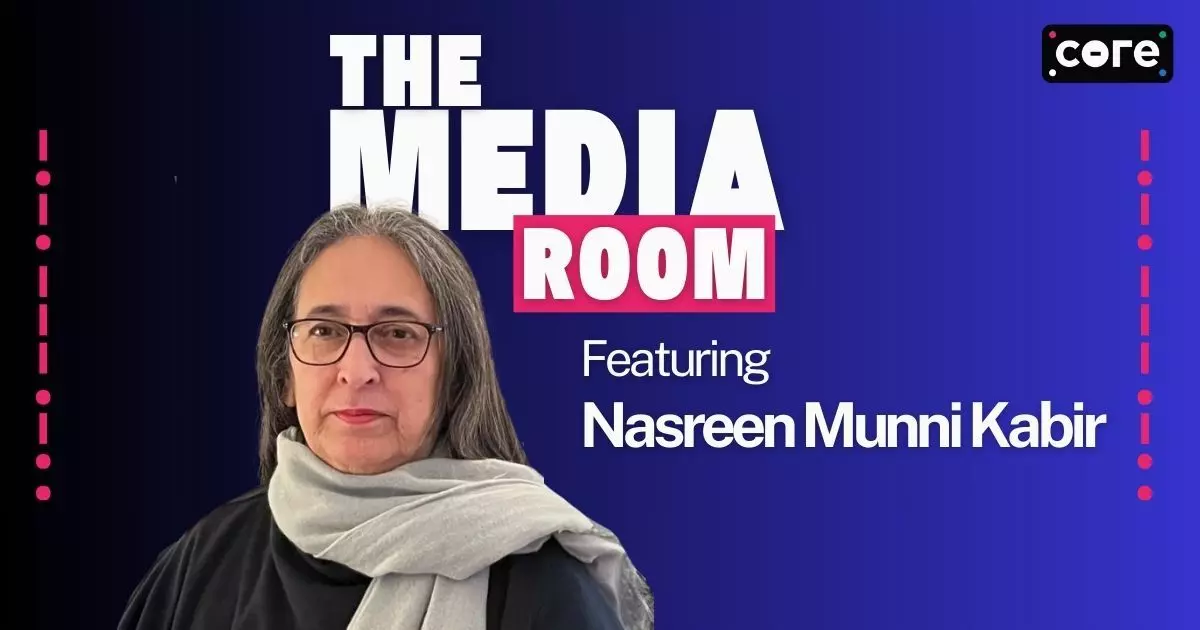
Nasreen Munni Kabir On Classic Hindi Films, Bimal Roy, SRK, Raj Kapoor & All Things Cinema
- Podcasts
- Published on 13 Feb 2026 5:00 PM IST

Exploring Film History, Storytelling Craft & Cinema’s Global Cultural Impact
In this episode of The Media Room, host Vanita Kohli-Khandekar speaks with film historian, author and documentary filmmaker Nasreen Munni Kabir about her lifelong journey documenting, curating and championing Hindi cinema for global audiences. From introducing British viewers to Indian films through her landmark Channel 4 series Movie Mahal to serving on the board of the British Film Institute, Nasreen reflects on how cinema became a cultural bridge for diaspora communities long before the internet connected the world.
They discuss what makes Hindi cinema uniquely enduring, how film songs sustained identity for immigrants abroad, and why classic filmmakers like Bimal Roy and Mehboob Khan continue to shape storytelling today. The episode also explores her work documenting icons such as Shah Rukh Khan, Lata Mangeshkar and Zakir Hussain, her collaborations with artists like Gulzar and A. R. Rahman, and what studying film masters reveals about craft, emotion and longevity.
The conversation further dives into criticism, authorship, preservation, and why cinema remains one of the most powerful cultural connectors across generations and geographies. Nasreen shares insights on what today’s filmmakers can learn from the past, and why understanding film history is essential to shaping its future.
Register for India Finance and Innovation Forum 2026
NOTE: This transcript is done by a machine. Human eyes have gone through the script but there might still be errors in some of the text, so please refer to the audio in case you need to clarify any part. If you want to get in touch regarding any feedback, you can drop us a message on [email protected].
Vanita Kohli-Khanderkar: Hello and welcome to the Media Room. Today, I have an unusual guest. I interviewed Nasreen Munni Kabir a couple of weeks back for a book I'm doing on Indian cinema and I enjoyed that conversation so much that I asked her to come on to our podcast.
Nasreen is an Indian-born person who's lived in UK since she was a kid and she has studied cinema studies. She's the one who introduced, I think, most of the UK to Indian cinema in the first place. In the 80s, she created this 46-part series called Movie Mahal for Channel 4 and for years, she's curated the Hindi films on Channel 4.
She's done various documentaries. Her most popular and the one which is her favourite is the one on Gurudwara. I think her last film is on Zakir Hussain.
She's done 15 and some of her documentaries. I think her last book is on Zakir Hussain. Her documentaries include one on Shah Rukh Khan, the inner and outer world of Shah Rukh Khan.
In Lata's Own Voice, a three-part series which she did. She has been a governor on the board of the British Film Institute. So, she's a voice for Indian, popular Indian cinema globally and she's studied the Masters for many years and especially Bimal Roy, Mehboob Khan and she talks about it in the podcast.
Nasreen and I had a fascinating conversation on everything to do with Hindi cinema. You know, from the Masters to the current filmmakers to why film critics are the way they are. Listening to it, if you enjoy Hindi cinema as much as I do.
Thank you.
Nasreen Munni Kabir: Thank you so much, Vanita. Pleasure to be here. Thank you.
Vanita Kohli-Khanderkar: You know, Nasreen, a lot of the work you've done is obviously around Hindi cinema. You've done a lot of... but what is it about Hindi cinema that fascinates you?
Because, you know, from Movie Mahal onwards, you've done so much with Rehman, Gulzar. I mean, you go through all of that but what is it about Hindi cinema that fascinates you?
Nasreen Munni Kabir: Because very frankly, you see many immigrant groups who moved away from India and who live in Europe and I was living in London. Their main contact with the homeland, so to speak, was food. If you were religious then there was religion but I was not.
And then films and more than films were the film songs. You carried them home. You took their 78s, then you took LPs and then you took EPs.
So, throughout the decades and I would say when there were a huge number of immigrants moving to England in from the 50s onwards and then the 60s, their main contact was with through cinema really. The lived contact because in those days there was no, you know, WhatsApp and there was no phoning every day. It was very expensive.
Even coming to India for holidays was very expensive. So, this new generation or the generation then, what was their way of relating? It was definitely the activity of cinema and it kept the language alive.
Now, if you are a Hindustani speaking, it will be Hindi cinema that you actually wanted to see simply because that was the language you understood and the songs were a very key factor in that connection because that's the music you would hear. You had The Beatles on one side and you had Lata Mangeshkar as well. So, you had this balance between the two cultures and cinema played and continues to play a very important role in that connecting and linking cultures.
Vanita Kohli-Khanderkar: Okay. And that is why it, that was an area of interest for you as a movie maker, as a researcher.
Nasreen Munni Kabir: It was not really even an interest. It was part of your life. It was like when you were growing up, you would see Indian films.
You didn't think of it as an interest. It was the fabric of your life included it. So, I didn't see it as a separate interest.
Later, when I started studying cinema, then it became more of a research interest. But before that, it was integrated into the everyday, just like eating rice and dal.
Vanita Kohli-Khanderkar: But you know, in the 80s, when you talk about the, you moved to the 50s.
Nasreen Munni Kabir: That's right, 50s, 50s.
Vanita Kohli-Khanderkar: Yeah. And that time, it was difficult to access our cinema. Absolutely.
I suppose. It's easier now. So, how did you get exposed to the cinema?
Nasreen Munni Kabir: Yeah. Various cinemas in London and all around England who would show Indian films, there were two or three distributors. Some of them were based in London, some in the Middle East or wherever.
And they would bring the Indian films and every Sunday, they would show the films from the 50s onwards. And when VHS came in the 70s, then their films were everywhere. Sorry, then when the VHS came in the 70s, the films were available everywhere.
Why? Because they were mostly pirated. But there was a huge market for them.
So, the Asian community in the UK, for example, were the first who bought VCR recorders and players en masse. Why? Because they would get these pirated videos.
You would rent a video for 24 hours for one pound. And really, you could see everything. The new, the old, everything.
So, pirating was really a big deal then.
Vanita Kohli-Khanderkar: But, you know, when you became a student of cinema studies, how did your view of Hindi cinema, did it change? What happened to your view of Hindi cinema? Did it become a little more objective, little less, you know, this is...
Nasreen Munni Kabir: I'm just curious about that. You see, the thing is that when I studied cinema as such, there was a certain amount of search for an understanding of the language, the cinematic language. And I found that certain directors, especially the 50s, had this language.
And that's why I zoned in on to the research of specific people. I was not doing blanket research. I was doing people from the 50s.
And what do you look for? You look for a certain understanding of the means in which cinema communicates. Now, what do I mean?
The use of the close-up, the use of the wide shot, the use of the crane shot, and then the story. So, the first thing I used to look at is how a film is actually shot. Then, I would think about the story and so on.
And that way, it became a kind of a research project and of great interest. But in the beginning, it was like anybody else, part of the audience.
Vanita Kohli-Khanderkar: Okay. No, but when you're studying... So, you said you looked at people in the 50s and 60s.
Which were the filmmakers who you started with researching and who were the ones who stood out?
Nasreen Munni Kabir: To be very honest, it was popular cinema more than Mr. Ray. And I started research in the 70s. And I was looking at four people from the 50s.
Mehboob Khan, Vimal Roy, Gurudutt, and Raj Kapoor. These four, I regard as masters of popular cinema. So, the research was mainly them.
I must say, I did not study filmmakers in depth after that, after these four. You know, if you said to me, are you an expert on Manmohan Desai? I'd say no.
I interviewed him at length and I interacted with him. But I was not studying his movies. There were other people doing that.
And so, you really studied. And I think out of these four, I studied Gurudutt most of all. Because I...
You did a book on him? Because I felt that he had a very individualistic style of his understanding of cinema. However, we must also say he passed away young.
And Mehboob Khan also passed away young. He was, in 1964, he was in his 50s. Vimal Roy was in his 50s.
Out of all these films, to be fair to the others, Gurudutt had, you know, he finished making films when he committed suicide and died at the age of 39. So, we don't know if he would have deteriorated, actually, in his 50s. Would he have made rotten movies?
Or what would have happened? You don't know. Time will not be able to tell you this anymore.
And the others, for example, with Mehboob Khan and Vimal Roy, they both died in their 50s. One was in 64, Mehboob Sah was 64 and Vimal Roy was 66. So, you had again a limited amount of creative life.
Then you see Raj Kapoor. Now, Raj Kapoor lasted much longer and also died young, relative to today's dying. But nevertheless, what happened was that you saw a deterioration.
If you cannot compare Ram Pehli Ganga Mehli to Awara, you cannot. It seems to be made by two different people. It's not just the times that have changed, it's the whole approach to storytelling had changed.
So, you can't, you see, you have to see the longevity of the artist.
Vanita Kohli-Khanderkar: What about Vimal Roy and Mehboob Khan and the others? If you had to compare them in terms of the body of work and how good or how much they deteriorated, for instance.
Nasreen Munni Kabir: To me, they did not deteriorate at all. And what you see in all four filmmakers, particularly the three you're talking about, Mehboob Khan, Vimal Roy and Gurudutt, they tried every genre, which means to say Mehboob Khan would make a melodrama, fantastic melodrama, Andaz. He made a costume drama, Humayun.
He made social films and he made many, many different kinds of films and Vimal Roy too. The other day, I was seeing some parts of Yehudi and Yehudi is a costume drama in the tradition of the Urdu Pashti theatre. Now, that film was released in the same year, 1958, as Madhumati.
But if you look at the two films, they are totally different. So you see that the filmmaker, once he masters the craft of filmmaking, he can apply it to many different narratives and genres and different types of storytelling. And that's what you see in these people very distinctly.
I'm not saying it's unique to them, but they were very good at this.
Vanita Kohli-Khanderkar: But have you studied filmmakers later? I mean, did you find any patterns which were interesting? I'm a bit curious because these are like masters, but in those days they were not.
Nasreen Munni Kabir: I mean, in the fifties and sixties and seventies, it took a while to recognise them to be masters, really. And I think the interest in Gurudwara Thakur really started in the eighties when he was around. And when he was around, it wasn't there.
Vanita Kohli-Khanderkar: You studied these four and in later filmmakers, do you see a pattern of how well they do over the years? Whether the work, if you had to draw parallels between these four or three, which you mentioned, Bimal Roy, Gurudwara Thakur and later filmmakers, what would the parallels be? What is it that sort of keeps them in the, because many of them, like Gurudwara Thakur said, became interesting people only in the eighties.
Nasreen Munni Kabir: Yes, the interest really started in the eighties. And I would say that, look, if you say basically the thing that unites them is their need to try different genres. Plus another very important aspect of their work is the fact is that they produce their own films.
When you produce your own films, you are not answerable to other people. Bimal Roy had his production company, Mehboob Khan did and Raj Kapoor did, Gurudwara Thakur did when he could, so that they don't have to be answerable to a studio boss who would determine what they would do. They were freer in that way, but they were also taking risks in cinema.
So if one film bombed, their money was gone, their money was gone. I remember reading a quote, I think in Ritu Nanda's book about her father, Raj Kapoor, and there was a discussion between Raj Kapoor and Krishnaji, his wife, and Krishnaji wanted him to buy a house. Well, Raj Kapoor said, first I should build the house, then the house will come.
But if I build the house first, the studio will never come, be built. So that is a very telling thing. Their first priority was cinema.
And in each case, they used the craft of cinema to tell very different stories. And that is important, to see how does, you know, a filmmaker should be able to tell all kinds of stories. And they did that very effectively.
However, in the case of Raj Kapoor, you cannot compare his later films like Ram Teri Garnamali, or Prem Rog, or whatever, to Awaraaj Shree Char Sobees. They are not considered, the later films are not in any list of classics. So it isn't me who's saying it, it is time that curates classics, time curates classics.
And these films are not in anybody's list as the milestones of Hindi cinema. So objectively, it is the early movies of their work. What makes a classic?
Something that does not date with time. Classic is something that stays relevant in any era. So you take something like, I was watching The Third Man recently, fantastic film by Alexander Korda.
And it's still relevant. And I remember Mother India, there was a few years ago on television, there was a programme, I think on Doordarshan about the plight of farmers. And then they had a shot of them, I think a woman or a man pulling the plough, pulling a plough.
This is I'm talking about not 15 years ago. And so in Mother India, that is what's happening. They cannot afford the oxen anymore, and they're physically pulling the plough.
So a classic is something that always finds a resonance in time as time passes. It could be an emotional reality, it could be a physical, I mean, economic reality, but there's an echo into many eras.
Vanita Kohli-Khanderkar: Is the messaging important to your mind, the story is important, the message, because a lot of that depends on the times in which that film is set. It is so contextual to the time you're making that film. So today, if you wanted to make a film on caste discrimination, the film, let's say Vimal Rao Meera, caste discrimination versus what is made today.
Nasreen Munni Kabir: It's totally different, but the emotions are the same. Now if there's an untouchable who has been supposedly the caste, which we don't call untouchable anymore, but who's adopted and then she discovers like in Sujata that she was adopted, even today there'd be drama, there would be drama. So it is not just what you call economic reality that resonates, it's also an emotional one.
And if these themes are universal, they often become emotionally relevant throughout time.
Vanita Kohli-Khanderkar: That's interesting. You know what you said about Raj Kapoor, I just want to pick on that point for a minute. You mentioned that he, but many of these people were just filmmakers at heart.
And you have a lot of them now also. But there is the fact is that if you do not make money, you cannot make the next film. How do you balance the dance?
Ultimately, the studios bring some money. So the art or the creativity is dependent on money.
Nasreen Munni Kabir: But I think one of the slightly, I mean, I can't say, but I think one of the problems is that the star today or the past 20 years has become far too important. And they want to call the shots, they call the shots. You have to please them.
And therefore the narrative gets ruined. And the director doesn't have a single vision. It's a fragmented vision.
So the films look as if they're not made by one person. They're made by the whims of many. That's what I feel.
And another thing is that if the star in the 50s, like Dilip Kumar, take Dilip Kumar, he didn't set up a Dilip Kumar productions and started ruling the roost. But nowadays, they want to control everything. And I don't think that's very good.
Because in Hollywood, you don't see Tom Hanks or whoever, Leonardo DiCaprio, setting up a production company so that they would control Martin Scorsese. They worked with him because they appreciated the directors. So very few people, directors today, have the clout that Mehboob Khan or Bimal Roy had in their time.
The authority. Now it's either the corporate who calls the shots or it's the star. How many directors honestly today can say, look, I don't know, I want to cast someone who is not the big star, but I want a big budget.
They can't do it. So it's all connected to how much money and the box office reality. And today, filmmaking is so expensive.
It's so expensive that they have to recoup. And nobody wants to risk their money. Whereas Bimal Roy risked his money.
Mehboob Khan made Son of India, it flopped. Kagas Ke Phool, Guru Dutt made it flopped. He lost a lot of money.
But the money there was much less. Not totally much less because you could buy a house for two lakhs. But it was, their heart was in filmmaking.
Today, I don't think anybody really wants to lose money.
Vanita Kohli-Khanderkar: I really don't know how you balance this thing, you know, because the fact is, the way we watch cinema, the way we watch films is cheap. This is no longer the time when people sit together and enjoy. It's very rare for audiences to enjoy one film together and discuss it.
Let's say the way an Amara would have been discussed or the way Mother India would be discussed. I think till the late 90s, early one of the millennium, the whole thing of common experiences was there. Theatres was there.
Because, not just because of streaming, but television and then streaming have broken that habit. So your audience has changed, the way it is consuming has, consuming may be a wrong word to use, the way they are watching your cinema has changed. And so has the way you, you know, the devices you're watching.
How does a filmmaker then, what does he do?
Nasreen Munni Kabir: I think he's in big trouble. He's in big trouble. Because the truth is that you're talking about an era where there was no competition.
There was just cinema. Then television came about. Then, I don't know, 400 stream channels, satellite channels.
And now it's like maybe 800 satellite channels and a number 12 streaming channels. And those, they provide web series, which actually people are loving. International web series.
So different classes are being, their entertainment is being catered for very easily. And in this, the climate, the filmmaker has no idea at all whether his film is going to appeal. However, nobody ever knew.
Manmohan Desai said to me once, if I knew what was a hit film, I wouldn't be making it. But I don't know what the audience is going to like. But today, whether the audience likes or doesn't like, their choice, the audience's choice is vast.
So out of five films in the 50s, one was going to work. Now out of five films in 2025, maybe none work. Because there's so many things that people can watch.
Plus another thing I really do believe, that films have become, or rather cinema going, has become an event. It's not just cinema going. So there has to be a lot of hype against around the film.
Like you take Durandar. Everybody must see Animal or Durandar because everybody's seeing it. In the West, the case was Oppenheimer and Mbabi.
It has to be an event, a social event. A small film that comes out is seen as a small film and won't make big, big money. So that there is, you know, it's a very different atmosphere of cinema viewing.
And there is no way, my dear, that we can go back. It's over. No, we can't.
Vanita Kohli-Khanderkar: No, we can't. But I always wonder, you know, in writing, for example, we say that it is, I write what I envision. For example, I'll write the story I want to write and it has to connect, it has to find.
But then the whole process between writing and finding that audience, that has got so, and similarly for filmmaking, so disrupted that, you know, you worry for the creator, but you also worry whether he'll survive.
Nasreen Munni Kabir: It's very, very difficult to be original anymore, really. So what is like, I would say, I saw Durandar, I'm not talking about the contents of it, but look at the way it's filmed. Look at the efficiency.
I thought the music research was excellent. I thought his use of old songs is very good, his editing, his photography. I'm not talking about the story.
That's another ballgame. But the fact of the matter is that you, you're making films that will actually have a huge market. So the market matters more than what the film is saying.
And every film has to say something, really. Whatever it is, it has to say something. What is an interesting example in recent times is the success of Sayara.
I find that a more interesting success. It means that young people want romance. They want new faces because they're fed up of the old faces.
And they want good songs. Now, this to me is a harking towards the earlier eras. And Sayara was a super hit.
And I'm sure it had touched a chord in a way that Durandar was a predictable chord, but not Sayara wasn't a predictable chord.
Vanita Kohli-Khanderkar: But if he knew what, like you said, if he knew what he works, then you cannot make a science out of this. But are there other flashes of interesting cinema you see in Indian cinema right now?
Nasreen Munni Kabir: Yes, I like the Ikkis very much, Sriram Raghavan's work. I think it's a very, it's a film for grownups, to be honest, people who are more thoughtful. And it's one of the only anti-war films you see in Indian cinema.
Then I liked, which other film? I liked recently, it's not new, Newton, Amit Masoodkar's film, Newton. I thought that was very good.
I liked, I thought Laapata Lady was charming. I liked 12 Fail. I thought it was very, it felt very real.
So there are pockets of films that you like. But, and I liked even Rocky or Rani, because it was quite madcap. You know, Madcap and Ranveer was very good.
Ranveer is a very good actor. And so those films you like. But I don't know if I would sit down and start studying the career of that director.
No, not in the way that I worked with them.
Vanita Kohli-Khanderkar: Any directors in these films you'd like to study?
Nasreen Munni Kabir: I shouldn't say, but I don't think anybody to me matches the overall talents of Gurulal. Oh Raj Kapoor, Bimal Roy, oh Mehboob. No, no.
Vanita Kohli-Khanderkar: Sriram Raghavan, Vishal Prasad.
Nasreen Munni Kabir: Yes, but I just think I'm too old for this generation. It should be someone of this generation who likes, who was. I also see another thing that makes me more hesitant to work on today's people is the fact that there is no longer the same use of music or songs.
Because there are very few songs in Indian films today. They're mostly background scores. Now Durandar has used all the old songs.
Why? Why? Because they connect with the audience.
So my work has been with people who have used music and songs in a very traditional Hindi cinema way. Today most of the songs are used as a kind of embarrassment or quickly put in a song in the background. So for me, one of the main kind of important aspects of Hindi cinema language is missing.
So I'm not sure I would be the right person to study today's cinema.
Vanita Kohli-Khanderkar: You know, you've done documentaries on Shah Rukh, you've done, you did a documentary on Gurdad, Lata Mangeshkar, Mr Bachchan, yeah. Rehman, you've done a conversation with Javed, you've done, Bahida ji, you've done. You know, some of these people, all of these people are icons and we've all followed their work as an audience at some point or the other.
How tough or easy it is to get these people to talk and more importantly, how much of their personality shapes the work they do. I mean, vice versa, you know, I'm just, is that an osmotic, you know, so Gurdad's, I don't know. You know, how much of his, like Aseem did a book on Shashi Kapoor, who's one of my favourites.
I don't know if you read Aseem Chawla's book, lovely book, but Aseem never managed to meet Shashi Kapoor because he died by the time Aseem did that book. And I always wish that that was one missing element because his, so how much of the personality and the work are they parallel?
Nasreen Munni Kabir: Well, in Gurdad's case, I think that is very, the link is very obvious because he, because of his suicide, there is so many residents of his troubled mind in his work, especially Gagas Ke Phool, I would say, even more than Pyaasa. And so therefore, you could not make the same kind of documentary on Mehboob Khan because he doesn't appear in his films. Because Gurdad is acting in his films, you can evoke the personality through the clips, the choice of clips.
So that's a big difference. And he was a director while Shashi Kapoor is an actor. So how much inference can you make from the clips?
Because he's not speaking his lines, he's not speaking autobiographical lines. So there's a very different approach. My way of choosing the subjects is that I feel that with each subject, and Guzar Sahib as well, and Rehman, of course, is that you must be able to show five films of each personality and say, ah, these are classics.
If you can't even show five works, then they clearly, you can't say that they're going to make history. So in each case, you have great examples. Of now with Javed Akhtar, you've got easily five screenplays.
Guzar Sahib, you've got easily five major songs and screenplays. Waheeda Ji, you've got five, easy. With the Gurdad, three.
And then you've got Mujhe Ji Nedo and Guide. And you've Teesri Kasam, thus you've got six there. And then with Rehman, you've got many more than five films in which with Mani Ratnam especially, he's associated with classics.
So you choose people whose work comes first, not the celebrity status. You must say, okay, I can have a retrospective of Waheeda Rehman tomorrow, Guzar Sahib tomorrow, Javed Sahib tomorrow, and people will appreciate their talent. Hmm.
And they'll come to watch it. They come to watch it because of their talent, not because they're celebrities.
Vanita Kohli-Khanderkar: Correct, correct, correct. It's an interesting, see, I write largely on the business side. So, you know, for me, that's an interesting sort of objective measure to how do you analyse a cinema personality.
Nasreen Munni Kabir: And how do you separate the celebrity status from the talent, the true talent? It's the work. That's true.
Tell me quickly for Waheeda Ji, which are the five films? I'd say definitely Pyaasa, definitely Kagus Ke Phool, definitely Sahib Bibi, but then there is Mujhe Ji Nedo. I also thought Teesri Kasam was wonderful.
And then there's, of course, Guide. So that's six. Guide.
I wanted you to say Guide. Guide, yes. And I'd say Guide is even more important than Sahib Bibi because Sahib Bibi is Meena Kumari's film.
Vanita Kohli-Khanderkar: Yeah.
Nasreen Munni Kabir: And another charming film of Waheeda Ji is Chandvi Ka Chand. It's a lovely film. So you've easily got five films of Waheeda Ji's.
Easy.
Vanita Kohli-Khanderkar: Five films there. Five films there. Again, I'm going to take a contemporary, A.
R. Rahman. His body of work now, over 30 years, more than 30 years, phenomenal.
What would you pick from A. R. Rahman's work?
Nasreen Munni Kabir: I would say his films do a lot of work. All of them. Irruva.
Irruva is amazing. Bombay is amazing. His films with, I'd say, his films with Manisa.
Then you have his films. Rangeela is a very important film. Taal is a very important film as far as his work is concerned.
So you've got many more than five films. Even Slumdog Millionaire, he became really, Indian music became really popular in the West because of Jai Ho. There is no doubt.
And since then, there has been nothing. R. R.
R. is because of the dance, Natu Natu, not because of the song. And not because of the Latin.
Because the song and the dance was so extraordinary in R. R. R.
Natu Natu.
Vanita Kohli-Khanderkar: No, no, in Rangeela.
Nasreen Munni Kabir: It was the use of voices. The very, very different compositions. Very, very different.
And this, from the South to enter into the Hindi cinema world, that was the big breakthrough film for Rehman. Rangeela and Taal.
Vanita Kohli-Khanderkar: You know, I asked you this on the phone yesterday. You have any interesting stories about meeting these people? The Shah Rukh documentary for instance.
And I'm a big Shah Rukh fan. What was that like? What was that experience like?
Nasreen Munni Kabir: That was a very nice experience. And what had happened is that I wanted to make a documentary about him. And I know, who you must know, Sanjoy Roy, who's one of the founders of the JLF in Jaipur.
And he was a good friend of Shah Rukh's. And I told Sanjay, I want to make this documentary. So, Shah Rukh happened to be in London.
And he set up a meeting. And we met. And he said yes.
Now what, that was fine. But the other anecdote I felt more interesting was, I met, I wanted to learn something about classical music. Because to be honest, I had stopped learning too much new about Hindi cinema.
And I had two friends, Ayesha Sayani and Sumantra Ghoshal. And I knew that they had done films on Zakir Hussain. And I did not know Zakir Hussain.
And I was very kind of shy and awkward to ask Zakir sahib. I mean, I'm a film person, not a classical music person. And they introduced me to him.
And I remember he said, okay. And I gave him my conversation books with Lata ji and Rehman and Gulzar sahib. And then afterwards, he said, ah, so this is a leap of faith, is it?
And I said, yes, it's a leap of faith. And that was it. And I'm so glad I did it.
Because one of the great losses to Indian culture is the passing of Zakir Hussain. Honestly, because he brought the youth back to music. And he had such a vivacious, down-to-earth, kind of genius personality.
Very, very, very, very bright man. That was a serious loss.
Vanita Kohli-Khanderkar: I think once in a while you meet somebody who's a creative person, who's a master of craft, but also manages to mystify it. And classical music is a mystery to many of us. If someone demystifies it, makes it more accessible.
And I don't know if you agree, but in film making also, sometimes you feel that critics, the kind of films they like, you know, Shah Rukh himself said it at the Critics Choice Awards, that any film which Raja Sen likes, I know it's going to flop.
Nasreen Munni Kabir: Which film? Who likes? I'm sorry, I didn't hear that.
Vanita Kohli-Khanderkar: A critic called Raja Sen. And it was a critic. Oh, yeah, yeah, yeah.
Any film which Raja Sen likes, I know it's going to flop. But, you know, as the audience, you wonder what is it that you don't see which the critics see, or which a cinema expert sees. And then what connects is completely different.
So that schism always fascinates me. And I wonder, and sometimes that schism doesn't exist, like 12th film, you know. So you wonder where that schism arises, and how that schism can be filled.
Nasreen Munni Kabir: It always fascinates me. You know, you said a little earlier, what is the talent and what is personality?
Vanita Kohli-Khanderkar: Personality, yeah.
Nasreen Munni Kabir: The same applies to critics. I see their personality comes first.
Vanita Kohli-Khanderkar: Really?
Nasreen Munni Kabir: And who they are, yeah. I don't see many critics here that are that objective. It's a lot to do with who they are and what they like.
And that is criticism. It is, you follow X and Y, because, you know, you want to like what they like. You like their taste.
And that's why you follow them. So they have to be themselves. And I think sometimes I feel that they can be a little harsh, because they are forgetting that the films are made for this context.
And sometimes if you compare it to another context, whether it's to Hollywood norms or to European cinema norms, you're never, you know, you can't start comparing biryani and risotto. You can't. Biryani has its place and risotto has its place.
But they're both made of rice. But you have to think of the context in which things are consumed and made. And I think sometimes the critics have standards that don't apply.
Okay.
Vanita Kohli-Khanderkar: But do you think Indian critics are particularly not well-trained or? I'm just...
Nasreen Munni Kabir: Not restrained?
Vanita Kohli-Khanderkar: No, not restrained. Trained.
Nasreen Munni Kabir: I'm not insane. I don't know whether you can train a critic. I'm not sure whether we look at Pauline Kael, whether she was trained or...
I don't think they're trained. It's just that they write very well and they have a passion for cinema. I don't think there's such a thing as training.
I don't believe it. I think even if you look at the reviews that Abbasab did back in the 50s, he just saw films and he wrote what he liked. But today the critic has a lot of competition from YouTube and from the blogs and from the reels.
There are endless critics. Endless critics. A thousand.
I mean, there are some guys who have a really serious amount of followers. So, criticism is everybody's gift, if you ask me. You could ask a rickshaw-puller, what did you think of Dhurandhar?
And he'll tell you. And that's the criticism. So, criticism is widespread.
And I think the traditional established critics have a much tougher time today because there's a lot of kind of random information about films.
Vanita Kohli-Khanderkar: You've had so much exposure to different cinemas because you sit in the UK, you've done so much work for Channel 4, you've created their film programming for years. When you look at Indian cinema, whether it's today or 50 years back and you look at other cinemas, I mean, this is a question I've asked, where do we stand to your mind? How good, how bad are we?
You know, we do very well in our home market, but it's not such a big entity, let's say, we're outside. But what is your assessment of the cinema as a creative, sort of, performing art or whatever you call it, versus other cinemas?
Nasreen Munni Kabir: Well, I think that the popular cinema, like you take the 50s and even Karan Johar's films had a great appeal in certain countries. I think the popular cinema, when it uses the tools or the way Hindi films are traditionally told, the music, the melodrama, the family drama, they are very successful in their own terms. It doesn't mean that type of film is successful in the West.
The musical, for example, the use of music is seen as a great novelty in Hindi cinema. However, the genre of the musical is not popular in the West anymore. Now you will see another thing in the West and which is no longer in Hindi cinema as well, the love, traditional love story is also phased out.
Sayara is a rare example, but very often you will find that the traditional love story, even in Hollywood, is over. So, you had the Marvel films taking and so on. So, basically, I must say that, I don't know, the regional cinema in India, I think is making fantastically real films.
Now, whether they get through the Malayalam films or the Kannada films or the Tamil films, they are very, very good. The popular Indian film will have less appeal because they're too long for the Western audience. Two and a half hours, three hour film, they cannot sit for so long unless it's The Godfather or Gone With The Wind.
It has to be a serious epic, otherwise they won't sit through it. Another thing I really do believe, it's no longer subtitles, it's no longer subtitles because a lot of Korean films, why are the Korean dramas so popular around the world? Everyone's reading subtitles, they don't understand Korean.
I think somewhere it lies in performance. I think for the West, the Indian performance is a little too heightened. It's not realistic enough.
And if you see the Irani cinema, why is Irani cinema so popular? The performance is very subdued and also they are talking about situations that are every day, not extreme. And so, like separation.
And so, it comes really as something very moving. I saw a new film called Sentimental Value recently and that's a Norwegian-Swedish film with subtitles, but it tells you such a truth about personalities. Another thing people are very keen on, at least the world cinema audience in the West, are films that have a psychological truth.
And quite often you will not find psychological layering in characters in Indian cinema. Whatever the character is doing is he's doing, he's not thinking. And I remember one very interesting comment that Dilip Kumar made about Devdas.
He said when he was working with Bimal Roy, he said the question in Devdas is not doing rather than doing. Now, that tells you a secret about performance. You have to have an internal performance.
If you see Dilip Kumar in Devdas or in Andaz, he gives you an internal performance. And most times actors are out there.
Vanita Kohli-Khanderkar: But I think that kind of performance in today's day, I don't know how much I would appreciate it.
Nasreen Munni Kabir: I think you look at Iqees and you look at Jaydeep and even Dharmendra, that to me is an internal performance. It's doable. It's up to the director to encourage it.
Jaydeep is a totally internal performer. It's not what he says, it's what he looks like and what his eyes are telling him. That's true.
That's true. Not the stars. The stars are really out there.
They're telling you what to think, what to see, how wonderful they are and how talented they are.
Vanita Kohli-Khanderkar: I feel for the stars also at one level because I think too much of the commercial stuff rests on their shoulder. I can't imagine Shah Rukh now managing to do, if he wanted to do a small sort of offbeat film. It's impossible for him because the stardom has taken over the actor completely.
Nasreen Munni Kabir: I don't blame the star because the whole film rides on them being themselves. If Shah Rukh came along and came in old clothes and tried to behave like a rickshaw-wala, no one's going to accept it. No one's going to accept it.
So they are also trapped by their image and they are trapped by the commercial restraint. They're trapped and they're quite happy to be trapped. So let's not feel too sympathetic.
Vanita Kohli-Khanderkar: I'm talking more from, do you feel, I wonder if sometimes they feel that enough to get a meaty role and enough to wipe into a...
Nasreen Munni Kabir: I'm sure they would love to. I'm sure, like for example, Shah Rukh wanted to do Swades. Aamir has done various films that where he, I think he was very, very good in Deepa Mehta's Earth.
I think that was one of his best performances. But does he rate it as one of his best? I don't know.
But I think it was, and Salman has got trapped and always gets the same roles. But I think in Bajrangi Bhaijaan, he was very good. He was believable.
Vanita Kohli-Khanderkar: What about Dangal? You saw Dangal? I'm sure you saw Dangal.
Nasreen Munni Kabir: I thought that was, it wasn't my favourite.
Vanita Kohli-Khanderkar: Oh, I love the film. I know the pen. Yeah, I found it.
Nasreen Munni Kabir: Too long, too long. I'm very impatient and I'm sorry I have to admit this terrible feeling I have. But I start thinking, my God, every film to me is 40 minutes too long.
Okay, last play. As long as this, our conversation isn't too long either.
Vanita Kohli-Khanderkar: No, no, we are wrapping it up now. But tell me, of all the people you've interviewed, who's been the most fun? Who's the one you've enjoyed the most or learned from the most?
Nasreen Munni Kabir: Lata Mageshkar. Really? Tell me a bit about her.
By miles. Intelligent, intuitive. Now, look, if you interview an actor, right, or a director, he would know this much of the industry.
The films in which he acted in, his film, and so on. Lataji knew the whole gamut of directors, the whole gamut of lyricists, composers, and playback singers. So she had an overview of the industry, which only the playback singers and composers had.
They worked with many different people over many different years. And so that insight and that understanding of their industry, only this department has, the music department. Maybe if I did work on stunt directors, they would have it too, because they move from one set to another.
But an actor wouldn't. An actor doesn't have that level of overview. But she was intelligent, and her memory was astounding, astounding memory.
You would mention one film, and she'll tell you which film, and then she'll tell you the song. Out of the thousands of songs, she remembered everything. Amazing, amazing memory.
Amazing memory. And I also found her to be very personable. She would be very funny, witty, wonderful mimic, and a very unusual lady.
And a woman who kept her own position in a profession, which continues to be male-dominated. People were scared of Lata, and they should have been. Otherwise, they had no respect for women.
Yeah, that's true.
Vanita Kohli-Khanderkar: That's very well said, actually. It was a time when, and even now, it's a pretty male-dominated time, I agree. Even now.
Well, you have a few female directors, though I don't think you have enough, I don't see female lyricists and music directors that often. But I don't know if it's a glass ceiling, or it is just talent doesn't come up. I really don't know what.
So you see Sneha I don't know what she did. She did work with Anuradha Kashyap. Sneha Khandilkar.
She was, I liked her work. But what about, okay, last, I know I asked you this, I said last question. You know, Javed Saab has become very popular with young people now.
I don't know if you know this. His reels are- Yeah, I think his interviews with stand-ups are particularly good. Yeah, he's become very, and I was like, you are discovering Javed Akhtar now?
I mean, what a shame. But you know, I come from my generation. But what was he like as an interviewer?
Did you have a ball talking to him?
Nasreen Munni Kabir: He's a brilliant interviewer. He is brilliant because he thinks on his feet. And even if he doesn't know something, he will have analysis and insight.
So he will approach most subjects with analysis and insight. And that is very lacking when majority of people give you information and anecdotal information, while he gives you a thinking about a subject. And that is rare.
To be honest, most people are giving you just information. I went there and this happened.
Vanita Kohli-Khanderkar: He reads, I think, he reads a lot.
Nasreen Munni Kabir: Lovely. Yeah, he reads a lot and he's very, very intelligent. And that is, really, he is very intelligent.
Vanita Kohli-Khanderkar:
That's what they say about Shah Rukh also, that he thinks on his feet.
Nasreen Munni Kabir: I remember- Yes, but I see Javed Akhtar is also more rooted in Indian culture and language. Because he's of a different generation. I mean, he's 20 years older than Shah Rukh.
So he lived at a time when the greats were working.
Vanita Kohli-Khanderkar: Super. Lovely, Nasreen. This has been such a nice conversation.
I wish we could, you know, you and I need to have a glass of wine or whatever is your tipple to discuss it. Because I would love to just dig into your mind and your experience. This is a lovely conversation.
Thank you so much.
Nasreen Munni Kabir: Thank you so much. And well done, you. And I will definitely listen to your podcast.


