



 Newsletter
 Search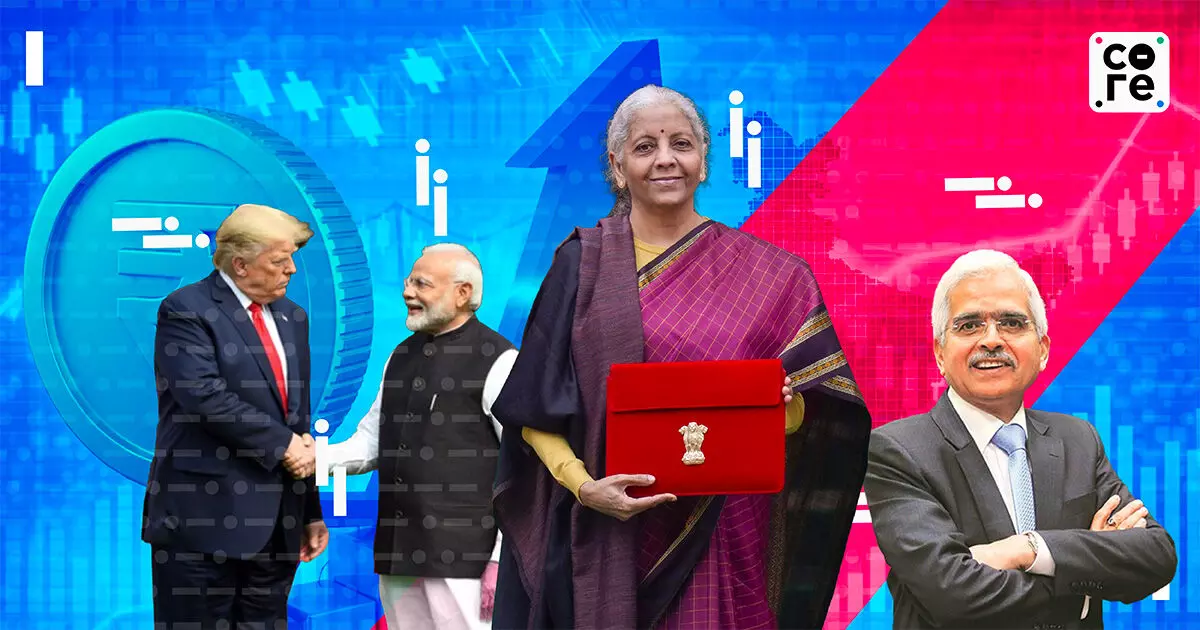
India’s Growth March Continues, Even As Reform Vision Pauses
 Rohini Chatterji
- Economy
- Published on 9 Feb 2026 8:32 PM IST
This year’s Budget too was expected to take the journey to Viksit Bharat ahead, with focus perhaps on the manufacturing and services sectors. It, however, stopped short of it.
India’s economy today stands out for its macroeconomic stability among global turbulence. Fiscal discipline and unflinching monetary policy have been the twin pillars of this stability. Sustained reforms, mainly with the intention of providing ease of business and impetus to scaling up, have finally upped India’s trajectory from 6.5% to 7% potential growth.
Announced against this backdrop, the Union Budget 2026-27 and the last monetary policy for fiscal 2025-26 have both chosen to maintain the status quo, only tweaking at the margins rather than opting for big bang announcements. The objective of both policies is domestic growth maximisation and stability.
After the vision of India being a Viksit Bharat 2047 was announced on August 15, 2022, every single Budget has focused on driving economic growth through high capital expenditure, infrastructure development and structural reforms; while the monetary policy has endeavoured to brace the financial system towards meeting the financial needs to fulfil this vision.
The budget has simplified the tax regime, allocated funds and incentives for traditional sectors, such as agriculture and MSMEs, as well as sunrise industries, such as lithium-ion batteries for electric vehicles and semiconductors. The idea has been to compound their positives and make them contribute more to overall economic growth.
The monetary policy has supported the budget each time by announcing measures to provide adequate liquidity and lower the cost of funds. It has also taken measures to strengthen the financial system and unleash its power to meet the financing needs of a growing economy.
This year’s Budget too was expected to take the journey to Viksit Bharat ahead, with focus perhaps on the manufacturing and services sectors. It, however, stopped short of it. It rather chose, encapsulated as kartavyas, to accelerate and sustain economic growth by ‘enhancing productivity and competitiveness and building resilience to volatile global dynamics’; to ‘fulfil aspirations of people and build their capacity, making them strong partners in India’s path to prosperity’; and to ensure that ‘every family, community, region and sector has access to resources, amenities and opportunities for meaningful participation’.
A reassuring trade deal with the US that was announced in between the Budget and the Monetary Policy, has actually reinforced India’s macroeconomic stability more than the conservative budget, and an MPC that have preferred stability over speeding to growth.
Pausing To Gather Breath
By not going after big bang measures and directing efforts towards seemingly smaller tasks, the government has indirectly recognised that development has many dimensions, not just achieving a threshold per capita income.
After decades of 3.5% Hindu Rate of growth of the 1950s-1960s, followed by the post-liberalisation era of 6-8% growth, India has consistently grown for more than five years, since the Pandemic, close to 8%. Projections made by several economic agencies indicate India’s growth momentum is likely to continue in 2026-27 with strong performance by the services and manufacturing sectors. In such a scenario, it is better to pause and take stock of what has been achieved rather than relentlessly running after what remains to be achieved and getting breathless before bracing again towards 2047.
Smoothening The Edges
And it is not as if the Budget has washed its hands of action. It has rather directed efforts towards smoothing out smaller edges. Take, for instance, announcements like developing India as a global Biopharma manufacturing hub, promoting medical tourism, giving a leg up to the orange economy, setting up all India institutes for Ayurveda, upgrading the National Council for Hotel Management and Catering Technology to the National Institute of Hospitality. These do not just recognise the ongoing efforts in these areas but also clearly demonstrate that these sectors will contribute to India’s visibility on the world map going forward.
The most significant measures in the 2026-27 budget are the ones that aim at employment generation and re-skilling. Adding 100,000 Allied Health Professionals over the next few years, for instance, or the creation of a cadre of ‘Corporate Mitras’ to support MSMEs, especially in Tier-II and Tier-III towns. While fulfilling a gap, such a measure will also generate employment at the local level in a meaningful way.
Similarly, the Budget has extended support to states in the North-East to promote tourism and to states like Odisha to develop the rare earth corridor and waterway. As stronger states set their foot in the global markets, as was evidenced by ten states participating in the recently concluded World Economic Forum at Davos to attract global investments, the Budget has attempted to bring the laggards to the forefront so that they too contribute and benefit from overall growth.
Missing A Step?
Aiming for macroeconomic stability to make growth sustainable is a worthy goal in itself. However, the shared caution of the Budget and the Monetary Policy misses the clearer structural bets that are now needed to propel the growth momentum. The Budget did not give any direction to make India a manufacturing hub for the world. The corporate sector and investors needed that direction to commit new capex to expand capacities to cater to domestic and global consumers. Capacities cannot be created overnight.
Similarly, neither the Budget nor the monetary policy provide a concrete plan for the consolidation of public sector banks, the chatter for which has been in the public domain for some time now. The Budget proposal of a committee for an overall review to ‘align the sector with India’s next phase of growth, while safeguarding financial stability, inclusion and consumer protection’ is a time-consuming path. The banking sector is currently on a strong footing as never before, and provides space for strong reform. Spending one full year in processes can prove costly in the journey to Viksit Bharat.
Starting this year’s budget, it was also necessary to look beyond 2041 when India’s demographic dividend starts waning, as an ageing population can well become a hurdle in the growth path. Albeit the negatives of that will take some more time even after 2041 to hurt India’s growth. It is nevertheless important to be firmly on the road to Viksit Bharat much before that.
Growth Chugs Along
As of now, between the Budget and the Monetary Policy, the Indo-US trade deal has brought some cheer to the market. By lowering US tariffs on India to 18% from 50%, the deal will give a major competitive advantage to India’s exporters. More importantly, it will turn around the private and foreign investor sentiment by ending uncertainty rather favourably.
Higher foreign funds inflow and lower oil import bill will help improve India’s balance of payment, ease the pressure on the rupee as well as manage inflation in the medium term. The agreement, the details of which are yet to be announced , will hopefully look much beyond Trump and make not only the two countries but also the world benefit from the two largest democracies coming together.
Meanwhile, the growth momentum will continue in 2026-27, as evidenced in the RBI’s revised growth projections marginally upwards to 6.9% in Q1 FY27 and 7% in Q2 FY27 after a year-on-year growth of 7.4% in 2025-26. Goldman Sachs too has upped India’s GDP estimate for the Calendar Year 2026 by 20 basis points, bringing it to 6.9% year-on-year. And the Indian juggernaut chugs along slowly and steadily at least on its annual growth journey.
Rohini Chatterji is Deputy Editor at The Core. She has previously worked at several newsrooms including Boomlive.in, Huffpost India and News18.com. She leads a team of young reporters at The Core who strive to write bring impactful insights and ground reports on business news to the readers. She specialises in breaking news and is passionate about writing on mental health, gender, and the environment.
Core.
Core.


